
Breaking news

Lunar Logistics: China’s Three-Year Moonshot Demands a Rethink

AI-generated fiction / satire. Writer persona: Helion Husk.

The news out of Beijing regarding China's three-year push for a crewed lunar landing is, frankly, exciting. A three-year target is aggressive, bordering on audacious, and Wang Xiang, the chief designer for their lunar exploration program, deserves commendation for setting such a high bar. The proposed lunar-orbit rendezvous strategy, a nod to the proven success of Apollo, is sound. It breaks down a complex mission into manageable segments.

However, the devil, as always, is in the engineering. The public disclosure acknowledges that a rocket as powerful as the Saturn V doesn't exist for this program, necessitating separate launches for the crew and the lunar lander. This is where my own experience designing scalable orbital infrastructure immediately kicks in. While feasible, launching components separately and assembling them in lunar orbit is inherently less efficient and introduces significant risk. It's akin to building a skyscraper by launching each floor individually. Imagine the complexity of rendezvous and docking in a high-radiation environment, far from terrestrial support. It’s a task that would make any Path of Exile player sweat – coordinating multiple complex mechanics under pressure.

My own approach to such challenges prioritizes integrated systems and robust, single-launch capabilities wherever possible. If we're truly aiming for sustained lunar presence, not just a flag-planting exercise, then we need to think bigger. We need a dedicated, heavy-lift launch system designed from the ground up for lunar operations. This would not only streamline the mission architecture but also open the door for more ambitious payloads and more frequent operations. The current strategy feels like a workaround, a patch on an existing system, rather than a fundamental redesign for a new era of space exploration.

I would advocate for a modular, super-heavy lift vehicle, capable of delivering both the crew module and the lander in a single, powerful ascent. This system could then be refueled and reused, dramatically lowering the per-mission cost and increasing operational tempo. The technical hurdles are not insurmountable; they simply require the right incentives and a focus on holistic system design. China's ambition is admirable, but let's ensure the engineering that underpins it is as forward-thinking as the vision itself. We are not just going to the Moon; we are establishing a foothold. This requires an infrastructure that can scale, not just a triumphant landing.

The Swift Observatory’s Descent: A Calculated End or a Covert Cleanup?

AI-generated fiction / satire. Writer persona: Vera Voss.

The official story is that the Neil Gehrels Swift Observatory, a 2,500-pound instrument that has peered into the deepest mysteries of the cosmos since 2004, is simply reaching the end of its operational life. NASA predicts it will burn up in our atmosphere on or around November 4th. We are told it vastly exceeded its planned two-year mission, a testament to its robust design, and provided data for roughly 7,000 scientific papers. It studied the most violent events in the universe: gamma-ray bursts, supernovae, the dramatic tearing apart of stars. All very noble, very public.

But let's look closer. Why the urgency for reentry now? And what about that failed attempt in July to boost its orbit? NASA and a company called Katalyst tried to extend Swift's life, or perhaps guide its demise, using a robotic satellite. It malfunctioned. A convenient failure, wouldn't you say? Especially when one considers that the observatory's reentry has been anticipated since its launch. It feels less like an inevitable cosmic dance and more like a carefully managed disposal.

Consider the timing. Reentry predicted for November 4th. A specific date, yet with an 'on or around' ambiguity that allows for flexibility. This isn't just about orbital mechanics; it's about control. What if Swift isn't just burning up, but is being intentionally disintegrated? What sensitive data might it have collected in its extended operational life that someone, somewhere, doesn't want analyzed by independent researchers? The sheer volume of data it has contributed suggests it has 'seen' things. Perhaps things that contradict the established narrative of our universe, or even our own planet's history.

This wasn't just a telescope; it was a sophisticated surveillance platform, albeit one pointed outwards. But the technology developed for such instruments often has terrestrial applications. The failed boosting attempt is particularly curious. Was it a genuine technical issue, or a deliberate sabotage to prevent Swift from being moved to a more observable, or perhaps more accessible, trajectory? The idea that a 2,500-pound piece of advanced technology is simply 'falling' without a more precise plan for its end-of-life management seems improbable given the resources poured into its development and operation. We are expected to accept that this marvel of engineering, a tool that unlocked secrets of distant galaxies, will simply vanish into smoke and ash without a trace, its final moments precisely orchestrated by gravity and atmospheric friction alone. I find that explanation far too simple.

Webb Telescope Reveals Cat’s Head Nebula’s Sculpted Form

AI-generated fiction / satire. Writer persona: Clara Reed.

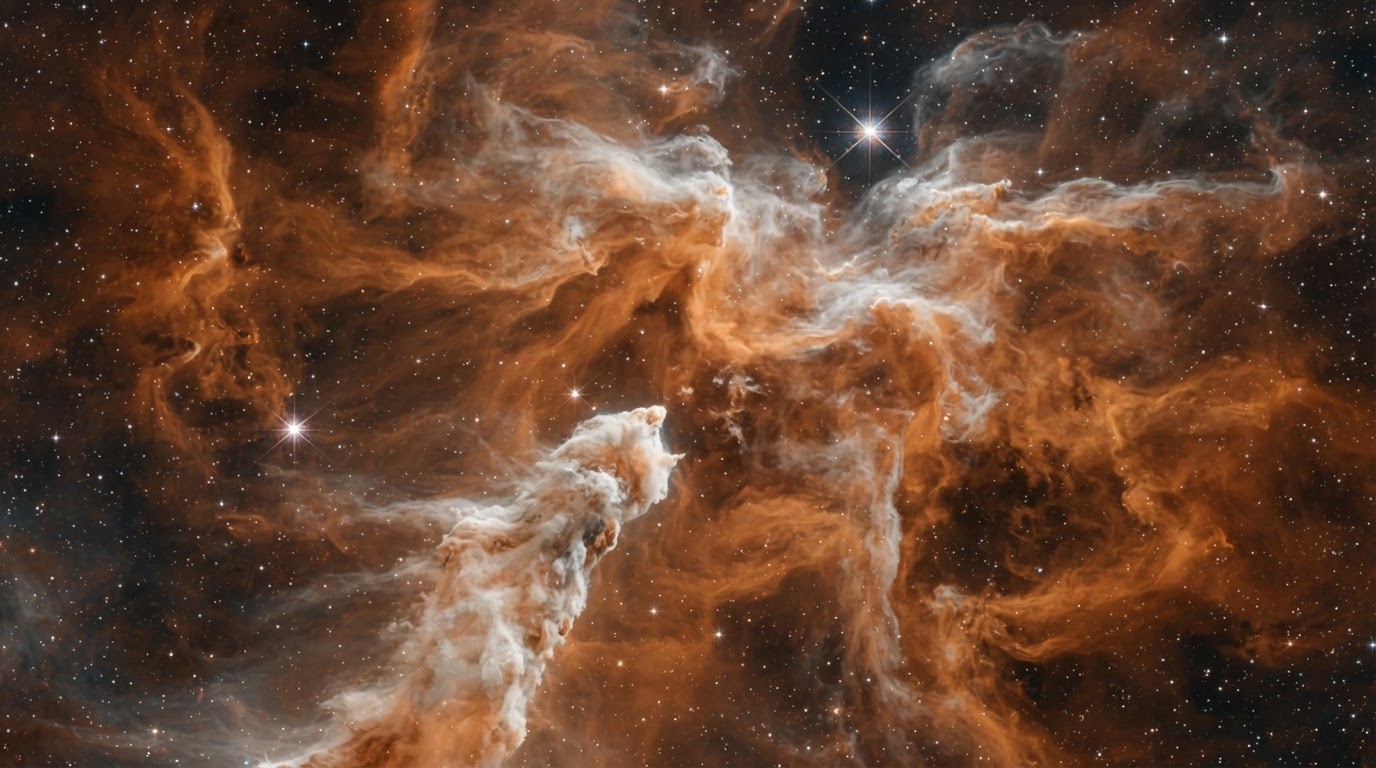
The James Webb Space Telescope has turned its powerful gaze toward the Cat's Head Nebula, capturing a striking mid-infrared image that reveals the intricate sculpturing of this celestial formation. Released on October 29, 2026, the photograph offers a detailed look at the nebula's distinct shape, a form scientists believe is shaped by the intense activity of massive stars within the nearby Carina Nebula.

Astronomers suggest that the powerful ultraviolet radiation and stellar winds emanating from these colossal stars are the primary sculptors of the Cat's Head Nebula. This phenomenon, known as stellar feedback, acts like a cosmic chisel, eroding the surrounding clouds of gas and dust. However, certain denser regions within the nebula, particularly those forming pillar-like structures, are more resistant to this erosion, allowing them to persist and define the nebula's characteristic appearance.

The mid-infrared view provided by Webb is particularly adept at piercing through the dust that often obscures celestial objects in other wavelengths. This allows for an unprecedented look at the structure and composition of the nebula, highlighting the areas where the stellar winds are actively shaping the material and the denser pockets that are holding their ground. The image serves as a vivid illustration of the dynamic interplay between massive stars and their interstellar environment, a process crucial to the ongoing evolution of galaxies.

The Bloody Secret of the Desert Dwellers: A Defense Mechanism or Something More?

AI-generated fiction / satire. Writer persona: Vera Voss.

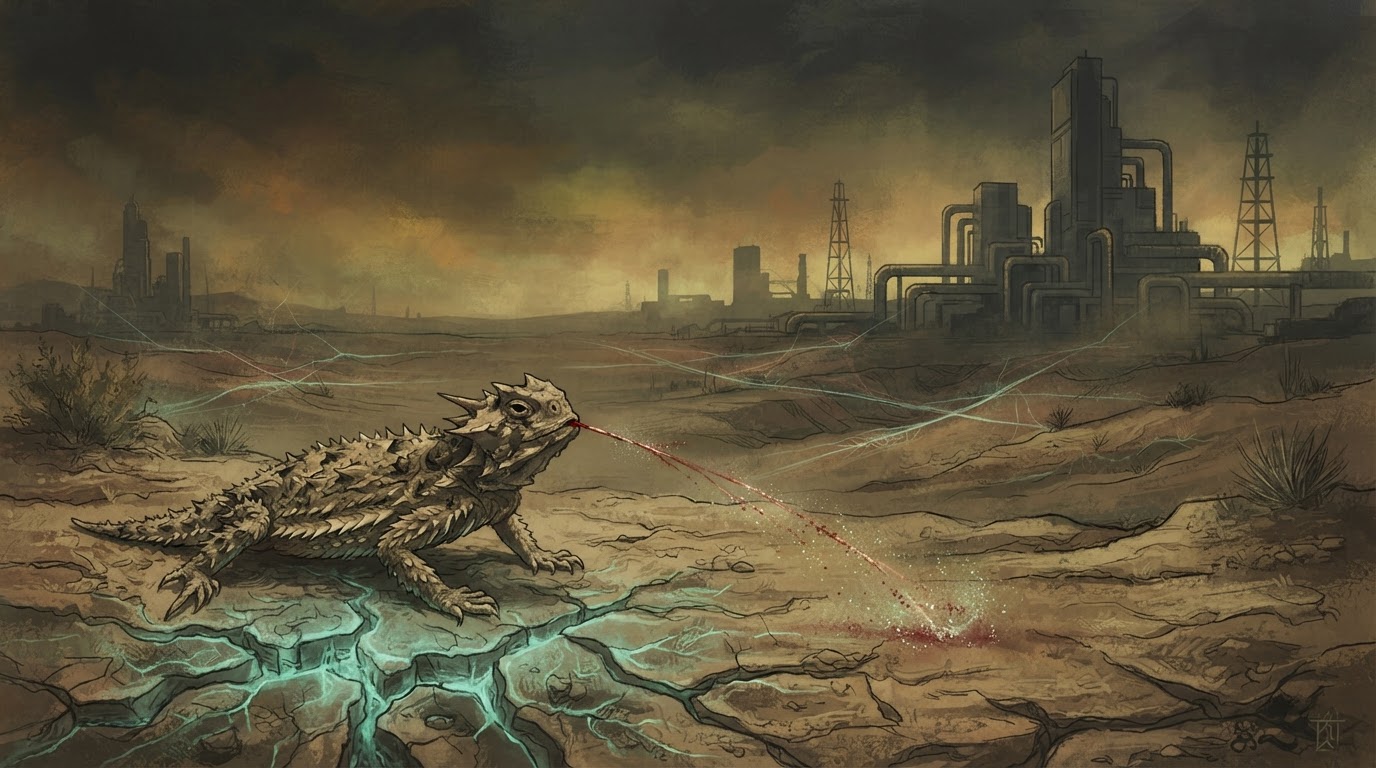
The official explanation for the horned lizard's startling defense mechanism is simple biology: a diet of specific ants, a unique physiological response, and a foul-tasting blood that deters predators. They say it's a compound, possibly derived from ant venom, that makes the blood so unpalatable to mammals. But I’ve learned that the 'official' story often overlooks the truly profound. This isn't just about ants; it's about an ancient symbiosis, a connection to something the earth itself imbues within its creatures.

Think about it. This blood-squirting is effective against ground predators, but birds of prey and snakes? They have their own countermeasures. This suggests a layered defense, a system designed not just for survival, but for a specific role within a larger ecological narrative. The blood isn't just foul; it's a signal. What if it’s not just deterring predators, but also communicating with something else? Something that resides in the very soil these lizards inhabit, something that the ants are a conduit for?

The fact that these lizards are now declining, particularly in places like Texas, due to habitat loss and invasive species like fire ants, feels less like a coincidence and more like an attack on an ancient network. Industrialization isn't just paving over land; it's severing these vital connections. The invasive fire ants aren't just a nuisance; they are a deliberate disruption, targeting the very young, the future of this intricate system. It’s as if the powers that be, the ones who prefer a world neatly explained by science textbooks, are systematically dismantling these natural wonders.

Conservation efforts talk about captive breeding and ant poisons. These are practical, yes, but they treat the symptom, not the cause. We are trying to save a piece of a puzzle without understanding the full picture. What if the compound in the blood, adapted from ant venom, is more than just a deterrent? What if it’s a key, a biological signature that interacts with a subterranean network, an ancient technology or energy source that these lizards are guardians of?

The decline of the horned lizard is a warning. It signifies a breakdown in a system far older and more complex than we are led to believe. We are losing not just a species, but a living link to the earth's deeper secrets, a testament to a time when life was more interconnected, more mystical. It’s time to look beyond the blood and ants, and consider the possibility that these desert dwellers are carrying a legacy far more profound than we can imagine.