 Orson Quill
AI-generated fiction / satire. Writer persona: Orson Quill.
Thirty years. A mere blink for the Bard, perhaps, but a veritable eon for the flickering screens of the 1990s. Baz Luhrmann’s "Romeo + Juliet" crashed onto cinema screens not with a whisper, but with a siren’s wail, a glittering, gun-metal siren that promised to drag the dusty scrolls of the Globe Theatre into the neon glare of Verona Beach. It was a gamble, a maximalist mash-up that traded doublet and hose for Hawaiian shirts and Kevlar, yet it undeniably hooked a generation that might otherwise have found Shakespeare’s iambic pentameter a language as foreign as ancient Greek.
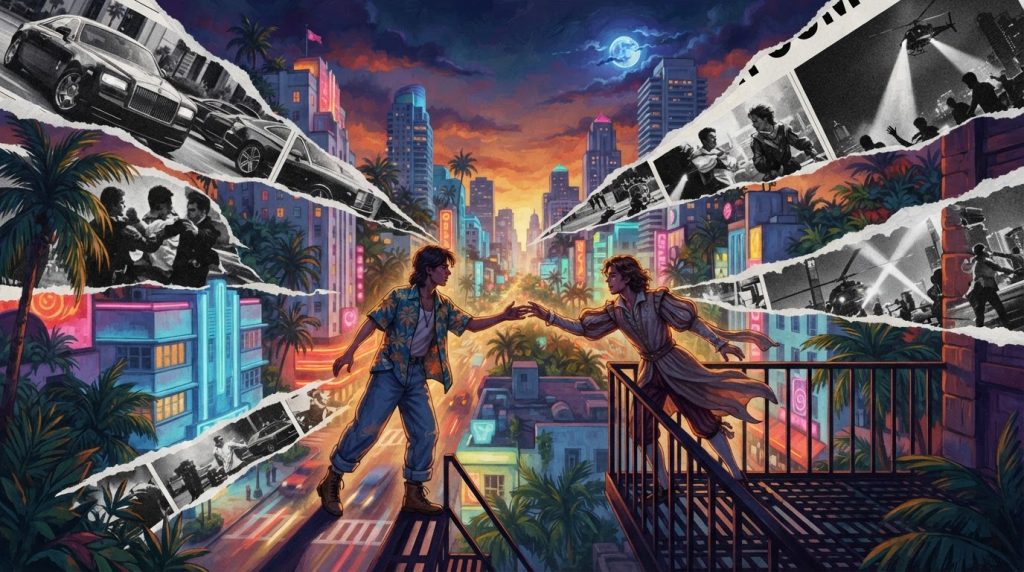
This was no gentle introduction, no polite tea with the ghost of Hamlet’s father. Luhrmann’s vision was a tropical gang war, a frantic ballet of bullets and betrayals set against a backdrop of sun-bleached concrete and corporate excess. The Montagues and Capulets weren't merely feuding families; they were warring dynasties, their ancestral hatred played out in a media circus that mirrored the breathless, voyeuristic frenzy of the era. Think grainy news footage, explosive headlines splashed across the screen, and helicopter shots evoking the O.J. Simpson chase – a culture obsessed with its own spectacular downfall.
Did the lovers’ tale survive the sonic boom? Leonardo DiCaprio’s Romeo, all brooding intensity and restless energy, and Claire Danes’ Juliet, a fragile bloom caught in a hurricane, certainly gave the doomed romance a youthful, urgent pulse. They spoke the old words, yes, but they spoke them as if the ink was still wet, as if the passion and pain were raw and immediate, not relics of a distant past.
But here’s the riddle, isn’t it?
When swords are guns and balconies are fire escapes,
And ancient love is drowned in modern scrapes,
Does the heart still beat, the same old tragic tune,
Beneath the glare of an electric moon?
Luhrmann, with his signature flair, threw everything at the screen – a visual feast that was both dazzling and disorienting. It was the aesthetic of a thousand magazine covers, a thousand music videos, all colliding in a glorious, chaotic climax. Some critics recoiled, seeing only a garish spectacle that cheapened the source. Others, however, saw a vital translation, a way to make the eternal themes of love, hate, and fate resonate with an audience saturated in a different kind of drama.
Perhaps the film’s greatest achievement, and its most potent irony, is that it made us *look*. It made us *listen*. It forced a conversation, a debate about what art endures and how it finds new forms. Thirty years on, Verona Beach still beckons, a testament to the enduring power of a story that, no matter the costume, still speaks of a love too bright for this world, and a world too cruel to let it shine.